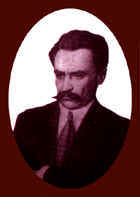
German Boris Wladimirovich
Before starting off, I want to invite you to read my 1st message, a sort of introduction. Thank you for reading.
I’m gonna start off this with a short true story I like very much. It was not a game-changing story, and you’ve probably never heard about any of the people mentioned in it. But I think this one is the best to start off with because it illustrates the commitment and willpower that will the drive behind our stories, the type of characters we will be dealing with, and the profoundly unjust and oppressive setting they took place in. It is the story of German Boris Wladimirovich.
German was born Russian, aristocrat and wealthy in 1876. Now, you need to think of a 16-24 year old guy that is going through the exact same things as you probably did around that age and a bit before (facing the world, and realizing that your parent’s Gods, Rules and Dogmas were utter and complete bullshit), while around him the exact same thing is happening on a full-blown society-wide level, and people are actually taking to the streets, demanding the end of that bullshit. He was a very well educated person, already an atheist with social-democrat thoughts, and he had surely pondered and fantasized about the day when the Zar would fall. Now shit got real. What was he gonna do? Stay with mom and dad in the walled estate? Or join the guys out there? Well, in German’s case (and probably many others!) it came down to a girl. He married a social-democrat activist and renounced to his inheritance and titles, and he joined the fight. He did it all the way. He participated in the 1905 Geneva Socialist conference, where he even went head-to-head with Lenin! That’s about the time when he became an Anarchist, a Libertarian instead of a Social-Democrat (which was about the time when this division was becoming more clear). He was excited, young, and living the revolutionary adventure.
But things in the 1st revolution, the 1905 one, went sour quite quickly, and he was deeply dissappointed. Where he had fought for freedom and for true Democracy, the Capital was taking over, and you could already see the outlines of a traditional eastern republic ruled by the ones with money. His wife died too, and I could not find much information about this, but I can picture what the guy was going through. He started hitting the bottle. And one morning he said “That’s it”, hopped on a boat and left for greener pastures. Off we went to Argentina.
We’re talking about quite the Rare Bird here. Throughout his life German was both a Biologist and a Medic, he wrote 3 sociology books, charted lands, spoke four languages fluently, was a succesful painter and wrote tons of panflets and anarchist material. A true renaissance man. He started off touring Argentina, living off whatever work he could find, which was not hard for a person for his qualifications (it was hard to find someone who could pull a spreadsheet back then), he even sold some paintings. He traveled to the north of the country, where he did the land-charting I was mentioning in Chaco. The air was fresh, things seemed to be picking up. But as he started spending more time in the city he saw that things were not all that different down here.
Just to put you in context, at the beginning of the century, approaching the 1st World War, Buenos Aires had an enormous amount of immigrants. It is, in the 1st half of the 20th century, the 2nd migration destination after the US, and it’s base population was much much smaller. At one given point, 1/3rd of Argentina’s population were immigrants. It was crazy down there, people cramming up in buildings up to two families in a room. You could walk through the street and hear four, five, six languages at any given point. And the worker’s rights were at zero. It wasn’t slavery, but it was damned close. People working 14, 15 hour shifts, entire families working, physical punishments, the whole shbang. And German saw this, and he was not any less sensitive to this than he was back in Russia. Soon, he found himself back in activism, and trying to fulfill an old dream of running an anarchist publisher, making magazines, books and panflets. But time had passed, and his companies had changed, and he was much more cynical now. He had gotten together with some italian folks (the italian anarchists were frequently quite hard-core), and in that particular context, with the level of unfairness that you could see on the street every day, and how individual action and the understanding of law as a tool of power were profoundly embedded in their ideal, it was not difficult to find a rational justification (or even a rational imperative) to actually go out and steal money from the wealthy to fund the spreading of The Idea. This is what they went out to do and failed (won’t go in the details here). He ended up in jail.
German had a very powerful presence. He looked a lot like Nieztche (Sorry, only pic I could find, really bad one, but illustrates the point I think), and he spoke with the same level of weirdness. People just didn’t know how to deal with this type of person. The governor of the province himself came to interview him, stayed with him for four hours. Of course, the justice system was not kind to political activists, and he was quickly sent to Ushuahia. Ushuahia is the most southern population of the world, and the jail that functioned there was basically the Argentinean Syberia. This looked like the end of the story for German. However, he stayed active while in jail, teaching prisioners to read, still spreading The Idea, maintaining contact with prisioner help associations, writing.
Back in Buenos Aires, something else was happening. A guy named Kurt Gustav Wilckens, a german anarchist, had shot to death one Lt. Colonel Hector Varela, who he deemed personally responsible for the massacre of over 1500 rural workers in Patagonia. Kurt Wilckens, in turn, was shot to death by an infiltrated right-wing activist by the name of Jorge Perez Millán. Millán was on the right side of power, so when his trial came, he was deemed unfit and temporarily demented and sent to a low security psych institution. The outrage of the movement was endless. Wilckens had commited a crime, and he had faced its consecuences like a man, and he was put down like a dog. His executioner, guilty of Wilckens’ same crime, was quickly forgiven and treated with enormous leniency. Word of this got all the way down to Ushuahia. Wladimirovich had never even met Wilckens. He had never known of his existence before hearing the news. He was some guy. But that doesn’t matter.
German started acting really weird. He did not teach people anymore, became silent and was seen often muttering to himself. As weeks went by, his condition got worse. He had forgotten how to read and was blurting out screams in the middle of the night. Finally, he was found in a pool of his own feces, praying, of all things! Praying! When the warden heard that Wladimirovich was praying, he knew this guy was out. They were not gonna get anything out of him, and they needed the room for new blood. He transferred him out, to a low security psych institution. Wladimirovich went and kept in character, acting crazy but showing mild recovery as to not get shocked out of his brain, and he scanned the place. He quickly learned there were two wards, one that was hi-sec, for normal people, and then a low-sec ward, where people like Perez Millán did some time with the leniency of power. Hi-sec guys could not go into low-sec. Except this one guy. This one dude called Esteban Lucich, who was pretty slow to start with, and in here he was shocked and medicated out of the little wits he had. The low-sec guys let him come in to clean the floors, polish their shoes, and little chores for some food. Wladimirovich very slowly started to get close to him, and started hammering The Idea into this carcass of a mind. Months came by, and he pulled it off. He had Lucich, he had convinced him. Sneaking in a gun into this place was a walk in the park for a well connected Anarchist. The next time Millán got a shoe polish, it came with 6 bits of led.
Lucich was mentally ill, so he was not liable for his actions. Every witness there were was a psych patient, deemed unfit for testimony. They never pegged the Perez Millán killing to him. Of course, he ended his days bitterly and in jail, and German’s life was probably marked and driven by reality not fulfilling his expectations. Every time German had high hopes on something, it came crashing down. The darkness this imprinted in him may have been his doom, but I’m quite sure that in the end that darkness and his commitment to The Idea were the forces that pushed this one last deed out of him, and in the end he got the last laugh.